

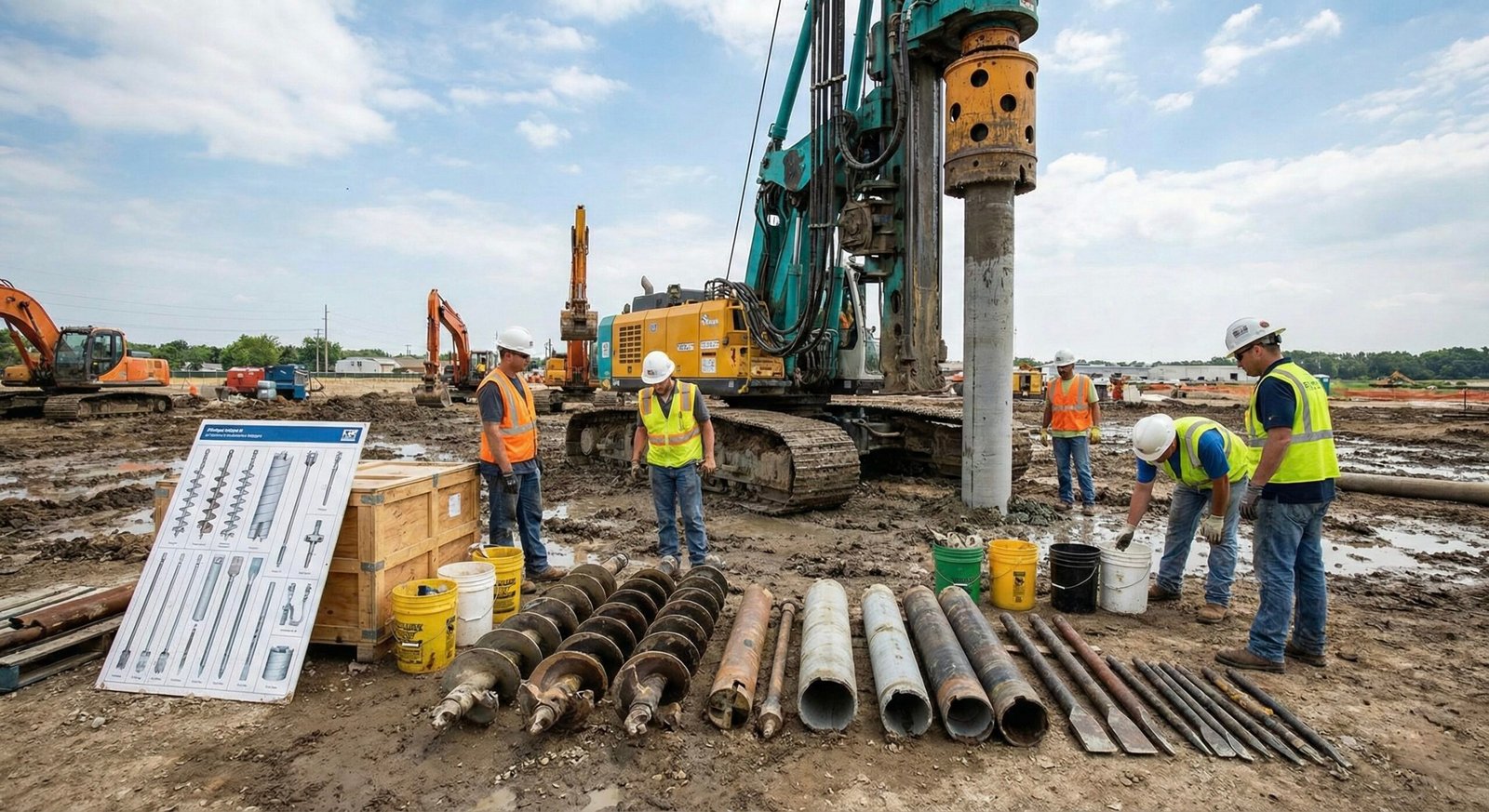
Understanding Piling Tools Used in Modern Foundation Construction
Foundation construction plays a critical role in the safety and longevity of any structure. In modern construction projects—especially high-rise buildings, bridges, industrial facilities, and infrastructure works—piling systems are widely used to transfer structural loads to deeper, stronger soil layers. At the heart of these systems are piling tools, which enable efficient, accurate, and reliable drilling and pile installation.
This article provides an overview of the key piling tools used in modern foundation construction and their importance in achieving safe and durable foundations.
What Are Piling Tools?
Piling tools are specialized equipment and consumables used during the drilling, excavation, and installation of piles. These tools are designed to work in varying ground conditions such as soil, sand, gravel, and rock, ensuring that piles are installed to the required depth and diameter with precision.
The correct selection of piling tools directly impacts:
- Drilling efficiency
- Pile quality
- Construction speed
- Overall project cost
Common Types of Piling Tools Used Today
1. Drilling Teeth and Cutting Tools
Drilling teeth, including bullet teeth, bucket teeth, and roller bits, are essential cutting elements used in piling operations. They are designed to penetrate soil and rock layers efficiently while offering high wear resistance and impact strength.
These tools are selected based on ground conditions, such as soft soil, mixed strata, or hard rock formations.
2. Drilling Buckets and Core Barrels
Drilling buckets are commonly used for soil excavation, while core barrels are designed for hard rock drilling. Variants such as rock drilling buckets, clean-out buckets, centrifugal buckets, and D-shaped buckets are used depending on geological conditions and construction requirements.
Core barrels with bullet teeth or roller bits are particularly effective in hard and abrasive formations.
3. Casing Pipes and Accessories
Casing pipes are used to stabilize boreholes during drilling, especially in loose or collapse-prone soil conditions. Single-walled and double-walled casings, along with casing joints, shoes, bolts, and drive adapters, form an integral part of full-casing construction methods.
Proper casing systems help maintain bore stability and improve construction safety.
4. Kelly Bars and Rotary Drilling Components
Kelly bars transfer torque and drilling pressure from the rig to the drilling tools. Depending on project needs, interlocking, friction, or combined Kelly bars are used. These components are critical for achieving the required drilling depth and performance.
5. Pile Installation and Extraction Equipment
Equipment such as vibratory hammers, hydraulic impact hammers, casing oscillators, and rotators are used for pile driving, extraction, and casing installation. These tools are especially important in urban or environmentally sensitive areas where controlled vibration and noise levels are required.
6. Testing and Monitoring Instruments
Modern piling projects also rely on testing equipment such as sonic tubes, pile integrity testers, ultrasonic drilling monitors, and seismic testing devices. These tools ensure quality control by verifying pile integrity, depth, and concrete quality after installation.
Importance of Choosing the Right Piling Tools
Using the right piling tools ensures:
- Reduced tool wear and downtime
- Faster drilling and installation
- Improved pile quality and structural safety
- Cost-effective project execution
Incorrect tool selection can lead to excessive wear, delays, bore instability, and compromised foundation performance.
Conclusion
Piling tools are the backbone of modern foundation construction. From drilling teeth and buckets to casing systems and testing equipment, each tool plays a vital role in ensuring that piles are installed safely, efficiently, and to specification.
Understanding the function and application of these tools helps contractors, engineers, and project managers make informed decisions, leading to stronger foundations and successful construction outcomes.
For reliable piling tools and foundation construction solutions, working with an experienced supplier ensures consistent quality, technical support, and dependable performance on site.